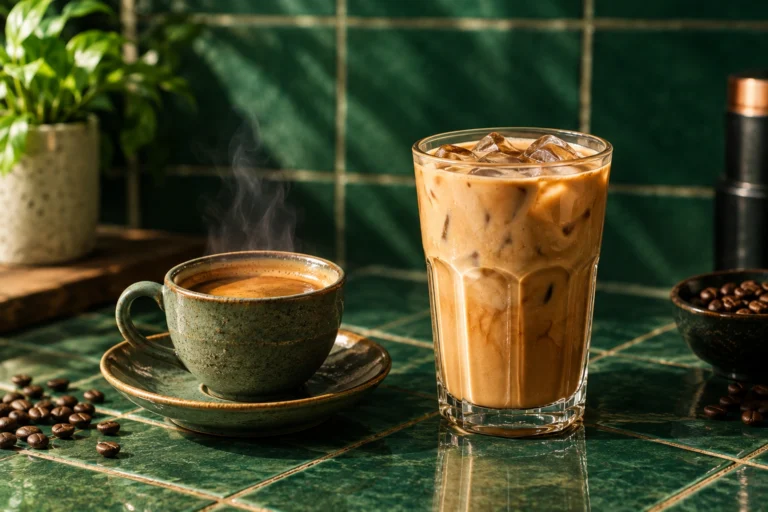
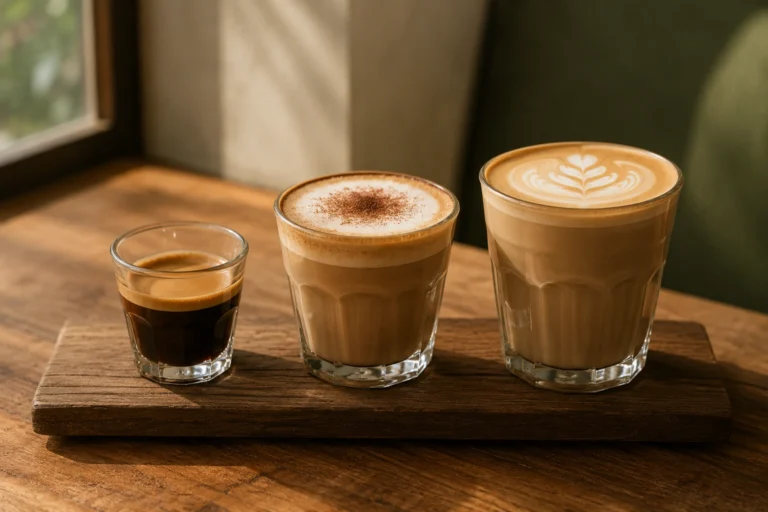
Most coffee conversations focus on what’s in the cup — the drink, the flavour, the name on the menu. Far fewer focus on how it got there. But the brewing method is arguably the single most consequential decision in the entire chain from farm to cup. The same specialty-grade bean, roasted identically, will taste dramatically different depending on whether it’s pulled through an espresso machine, dripped slowly through a filter, or steeped cold for twelve hours.
Understanding brewing methods doesn’t require becoming a barista. It just requires knowing what each method does differently, what that produces in the cup, and when one makes more sense than another. This guide covers the three methods that matter most for anyone engaging with specialty coffee in 2026 — espresso, pour over, and cold brew — with enough depth to be genuinely useful and enough restraint to stay readable.
What Brewing Method Actually Changes
Before getting into the specifics of each method, it’s worth understanding what brewing method actually controls — because it’s more than most people realise.
Every brewing method is essentially a different answer to the same question: how do we get the soluble compounds out of ground coffee and into a liquid you can drink? The variables it controls are extraction pressure, water temperature, contact time, grind size, and filtration. Change any one of these and the cup changes — sometimes dramatically.
Pressure extraction (espresso) produces a highly concentrated, emulsified liquid with compounds that don’t dissolve in regular brewing. Gravity filtration (pour over) produces a clean, light-bodied cup that passes everything through a paper filter. Cold water immersion (cold brew) extracts slowly over time, pulling different compounds than heat-based methods and producing something that tastes almost nothing like the same bean brewed hot.
These aren’t subtle differences. They’re fundamentally different drinks made from the same starting material. Understanding that is what makes the rest of this useful.
Espresso — Pressure, Concentration, Speed
How It Works
Espresso is brewed under pressure. Hot water — between 91 and 96°C — is forced through finely ground, tightly packed coffee at approximately 9 bars of pressure. The entire extraction takes 25 to 30 seconds and produces 25 to 30ml of liquid: a small, concentrated shot with a layer of golden crema on top.
That crema is unique to pressure extraction. It’s an emulsion of coffee oils, carbon dioxide, and water that forms when the pressurised water forces CO₂ out of the grounds mid-extraction. No other brewing method produces it. It contributes to espresso’s distinctive texture — thicker, more viscous than any other coffee — and carries a significant portion of the aroma.
What It Tastes Like
Intense and layered. A well-extracted espresso from specialty-grade beans has brightness at the front — often described as fruit or acidity — body through the middle, and a clean finish. A poorly extracted espresso from commercial-grade beans tastes flat and bitter, which is why espresso has a reputation for bitterness among people who’ve only encountered it in chain cafés using low-quality beans.
The concentration is real: espresso contains roughly 60–70mg of caffeine in 30ml of liquid, making it the most caffeine-dense beverage per ml of any brewing method. A pour over of the same beans in a 250ml cup might contain more total caffeine — but at a fraction of the concentration.
When to Choose Espresso
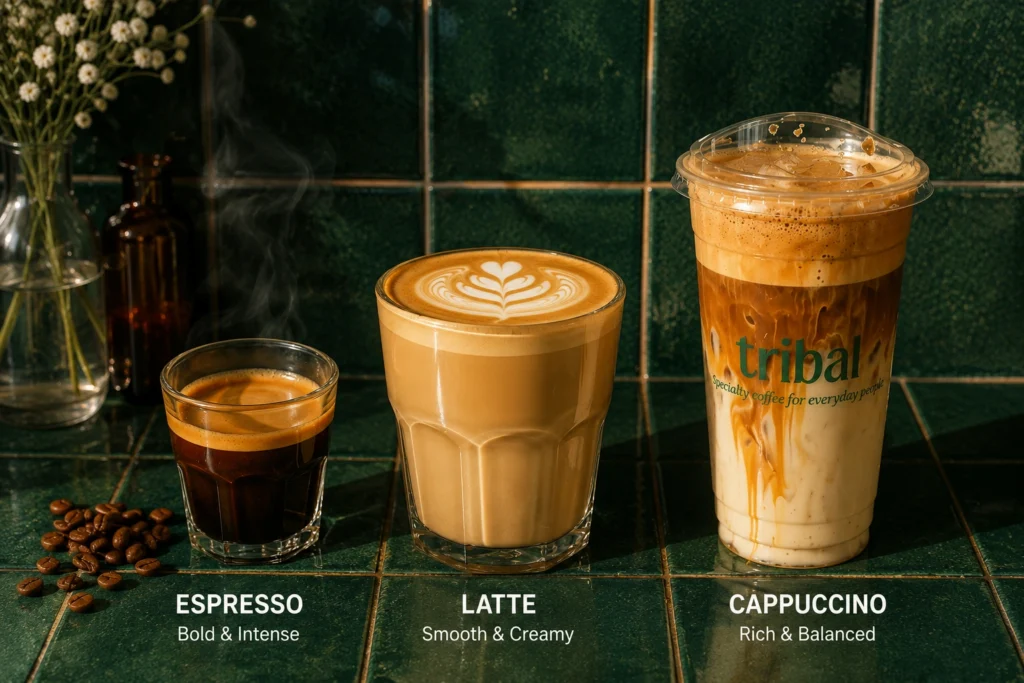
When you need fast, high-impact caffeine. When you want the most direct expression of the bean in the smallest volume. When you’re the base for a milk drink — espresso is what gives a latte, cappuccino, or flat white its coffee character. When you’re at a café and don’t want to wait five minutes for something to brew.
The full range of espresso-based drinks — from a straight double shot to a Flat White or an Americano — is available through the classic espresso collection at Tribal.
Pour Over — Gravity, Clarity, Patience
How It Works
Pour over is the opposite of espresso in almost every way. Where espresso uses pressure and takes 30 seconds, pour over uses gravity and takes three to four minutes. Where espresso produces a concentrated, emulsified shot, pour over produces a larger, lighter, cleaner cup.
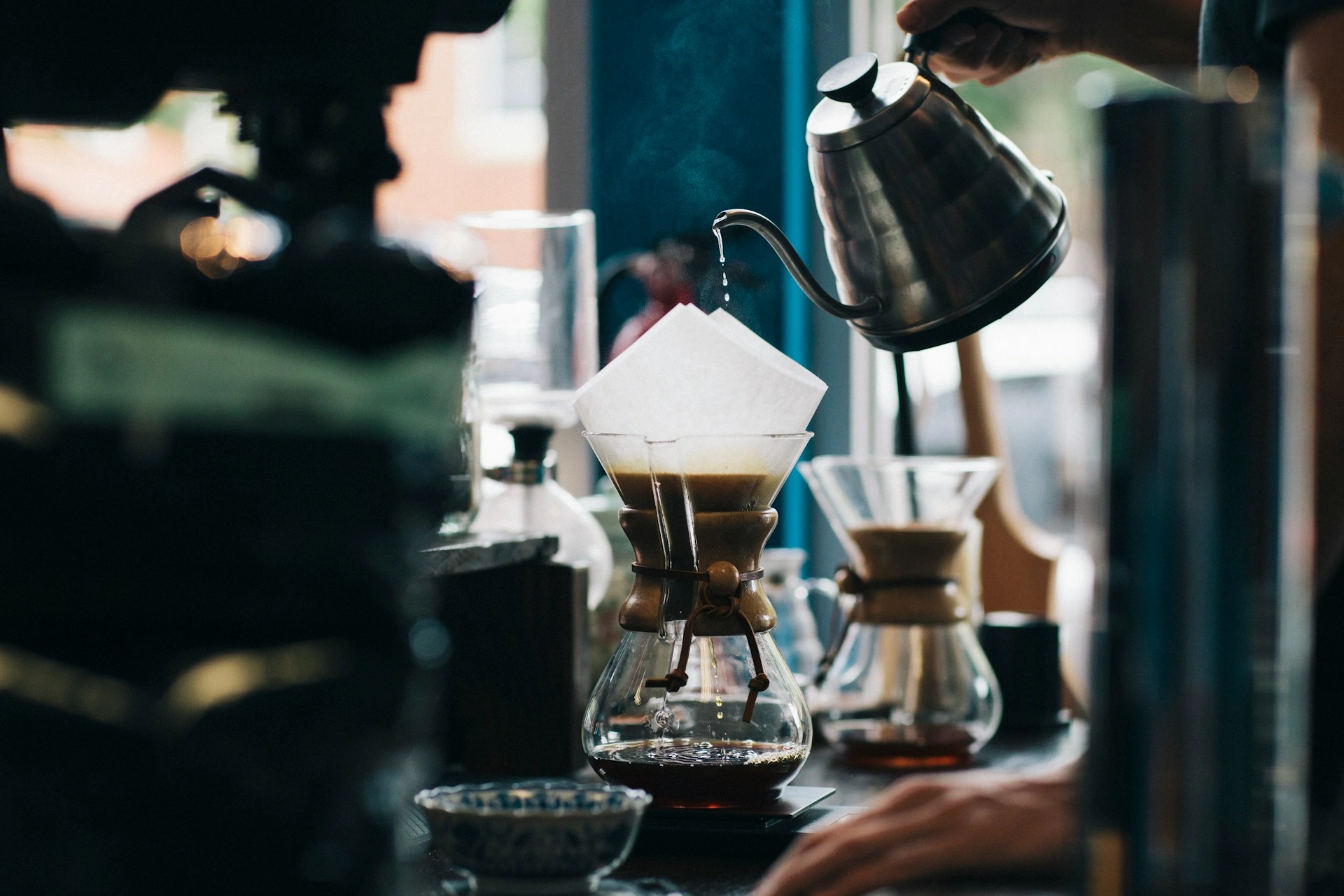
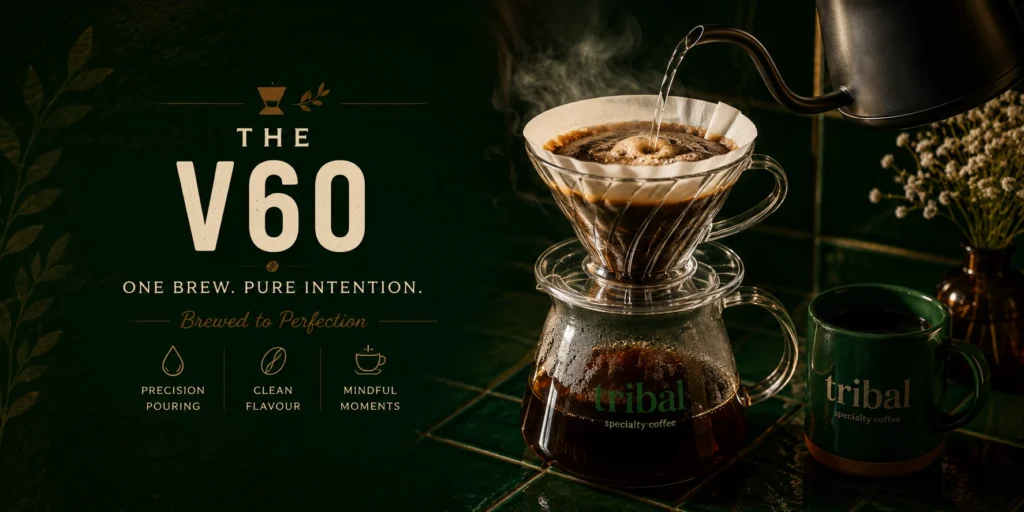
The V60 — the cone-shaped dripper used at Tribal’s slow bar — works by allowing hot water to move through medium-fine ground coffee at a controlled pace, extracting as it goes and draining through a paper filter into a vessel below. The paper filter is critical: it removes the coffee oils and fine particles that espresso retains, producing a cup that is noticeably cleaner and brighter in character.
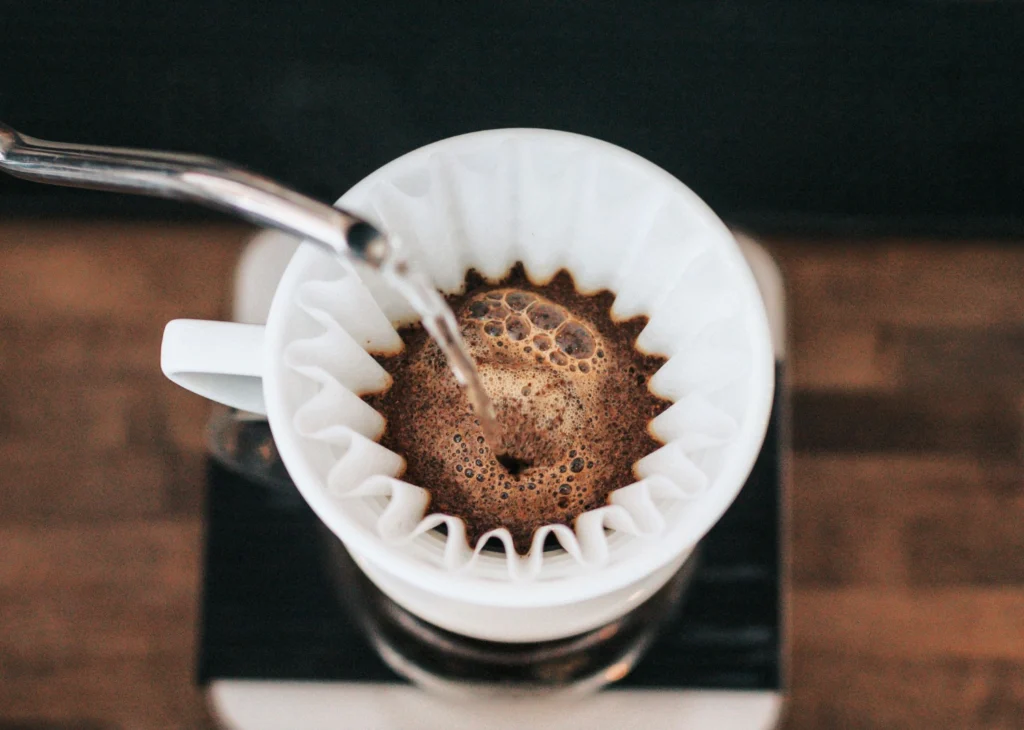
The pour itself matters. Water is added in stages — a bloom pour first, to allow CO₂ to degas from freshly roasted beans, then controlled spiral pours to ensure even extraction. Pour too fast and the water channels through the grounds without proper contact, producing an under-extracted, sour cup. Pour too slowly and you over-extract, producing bitterness. The precision is the whole point.
What It Tastes Like
Clean, bright, and layered in a way that espresso cannot replicate. Because the oils are filtered out, the cup has less body than espresso but considerably more flavour clarity — individual notes (fruit, floral, citrus, honey, chocolate, whatever the bean naturally carries) come through distinctly rather than being compressed into intensity.
This is why pour over is the preferred brewing method for single-origin specialty coffee. It shows the origin more clearly than any other method. A Costa Rican coffee brewed through a V60 will taste like Costa Rica — its altitude, its processing method, its varietal — in a way that the same bean pulled as espresso or steeped as cold brew simply won’t.
If you want to understand what a specialty coffee actually tastes like as an origin, the pour over collection is the place to start. Our Costa Rican Single Origin, brewed through a V60, is the most direct expression of this principle on the Tribal menu — bright, clean acidity, a natural sweetness, and a finish that tells you exactly where it came from.
When to Choose Pour Over
When you want to taste the bean rather than just the caffeine. When you have fifteen to twenty minutes to sit with something rather than knock it back. When you’re a habitual sugar-adder who wants to try coffee without it — pour over from quality beans is the most likely method to change that habit. When you’re at a café and the slow bar is an option.
Pour over is also the method growing fastest in Pakistan’s home brewing scene. As specialty roasters like Qahwah in Karachi and in-house roasters like Tribal in Lahore make single-origin beans more accessible, V60 kits are increasingly common in DHA and Gulberg homes — a direct extension of the third wave shift described in our guide to specialty coffee in Lahore.
Cold Brew — Time, Temperature, Smoothness
How It Works
Cold brew is the simplest brewing method to understand and the most counterintuitive to first-timers: there is no heat involved at any stage. Coarsely ground coffee is combined with cold or room-temperature water at a ratio of roughly 1:8 and left to steep for 12 to 24 hours. The long contact time at low temperature slowly extracts the soluble compounds without the heat-driven extraction that characterises every other brewing method.
The result is a concentrate that is then either drunk as-is (for a strong, black cold brew) or diluted with water or milk before serving. Unlike iced coffee — which is simply hot coffee poured over ice — cold brew was never exposed to heat at any point, which changes its chemical composition fundamentally.
What It Tastes Like
Smooth, low-acid, and naturally sweet in a way that hot-brewed coffee isn’t. Because heat is absent, the compounds responsible for brightness and acidity in hot coffee are never fully extracted — cold water pulls different things at different rates. The result is a coffee that most people find significantly more approachable than hot espresso or pour over, with none of the sharpness or bitterness that put people off coffee in the first place.
Cold brew also contains more caffeine per serving than hot coffee — <cite index=”4-1″>cold brew contains up to 67% more caffeine per serving compared to hot-brewed coffee, due to longer steeping and higher coffee-to-water ratios</cite>. This makes cold brew simultaneously the smoothest-tasting and most caffeinated option — a combination that explains its rapid rise in popularity across Pakistan, particularly in warmer cities and seasons.
When to Choose Cold Brew
When it’s a hot afternoon in Lahore and nothing hot sounds appealing. When you want caffeine without any of the bitterness or acidity of hot coffee. When you’ve tried espresso and found it too sharp or intense. When you’re introducing someone to specialty coffee for the first time — cold brew’s approachability makes it a more reliable entry point than straight espresso.
Cold brew also keeps. Made in a batch, it stores refrigerated for up to two weeks without significant flavour loss — making it the most practical home brewing method for anyone who wants quality coffee without the daily ritual of a V60 setup.
There’s no universally correct answer, but there are useful starting points depending on what you’re coming from.
If you already drink lattes or cappuccinos: you already know espresso — it’s the base of those drinks. The next step is trying a straight double shot to understand what your milk drinks are built on, or trying a pour over to experience the same bean in a completely different form.
If you find coffee too bitter or too sharp: start with cold brew. The absence of heat removes the compounds responsible for bitterness and acidity entirely, producing something that most people who don’t consider themselves coffee drinkers find genuinely enjoyable. It’s also the method most likely to change your relationship with coffee permanently.
If you want to understand specialty coffee properly: start with pour over. Specifically, a V60 single origin at a café that sources and roasts their own beans. The clarity of the cup makes the quality of the bean undeniable in a way that espresso, with its concentration and crema, and cold brew, with its smoothness, both partially obscure.
At Tribal, all three methods are available — espresso and pour over daily at the café, cold brew subject to availability. If you want to explore beyond what’s on the menu, the custom coffee builder is the place to start.
Frequently Asked Questions
What is the difference between espresso and pour over coffee?
Espresso uses pressure to extract a small, concentrated shot in 25–30 seconds. Pour over uses gravity and a paper filter to produce a larger, cleaner, brighter cup over 3–4 minutes. Espresso is more intense and has a heavier body; pour over has more flavour clarity and better expresses the origin characteristics of the bean.
Is cold brew stronger than espresso?
Cold brew contains more total caffeine per serving due to higher coffee-to-water ratios and longer steeping time, but espresso has a higher caffeine concentration per ml. Cold brew tastes smoother and less intense despite having more caffeine per cup — the absence of heat removes the compounds responsible for bitterness and sharpness.
Which brewing method is best for specialty coffee?
Pour over — specifically the V60 — is the method that best expresses the origin characteristics of specialty coffee. The paper filter removes oils and particles that obscure flavour clarity, allowing the individual notes of a specific bean from a specific farm or region to come through distinctly.
Can you make pour over coffee at home in Pakistan?
Yes — a basic V60 setup (the dripper, filters, a digital scale, and a gooseneck kettle) costs under ₨5,000–8,000 and is available through online retailers in Pakistan. The most important variable is the bean: freshly roasted specialty-grade coffee makes a significantly more noticeable difference to the result than the equipment itself.
Why does cold brew taste less bitter than espresso?
Heat is what extracts the acidic and bitter compounds from coffee grounds. Cold brew never uses heat at any stage, so those compounds are never fully extracted — the result is a naturally sweeter, smoother coffee that most people find significantly more approachable than hot-brewed alternatives.
Which brewing method has the most caffeine?
Cold brew has the most caffeine per serving due to the high coffee-to-water ratio used during steeping and the long extraction time. Espresso has the highest caffeine concentration per ml but is served in smaller volumes. A standard 250ml cold brew typically contains more total caffeine than a single or double espresso shot.
Not sure which method to try first? If you’re at Tribal, ask at the counter — we’re happy to walk you through the options.
DHA Phase 6 has quietly become one of Lahore’s most productive neighbourhoods to work from — not in an office, but in a café. The combination of a young professional and student population, reliable commercial development, and a growing number
Lahore has approximately five months of weather that makes a hot cup of coffee feel like a bad idea the moment it leaves the counter. From April through August, the city runs at temperatures that put anything steaming into the
There’s a specific kind of cold coffee that appears on specialty café menus and consistently confuses people who haven’t encountered it before. It’s called a shaken espresso. It sounds simple — espresso, shaken — and it is, technically. But what